Showing posts with label unit 2. Show all posts
Showing posts with label unit 2. Show all posts
Sunday, January 20, 2008


Wednesday, January 16, 2008
Tuesday, January 15, 2008
Class Notes 1/15/08


Here is today's class notes which should help with the benchmark that is due Friday.
Wednesday, January 9, 2008
Tuesday, January 8, 2008
Friday, January 4, 2008
Saturday, December 22, 2007
Friday, December 21, 2007
Integers
problem: -55+44=
explanation : your down -55 points you earned 44 more points. you have to go from negatives to positives. if this was on a number line you would go up from -55. you would move up 44. your answer would be -11.
Bianca Nigro
explanation : your down -55 points you earned 44 more points. you have to go from negatives to positives. if this was on a number line you would go up from -55. you would move up 44. your answer would be -11.
Bianca Nigro
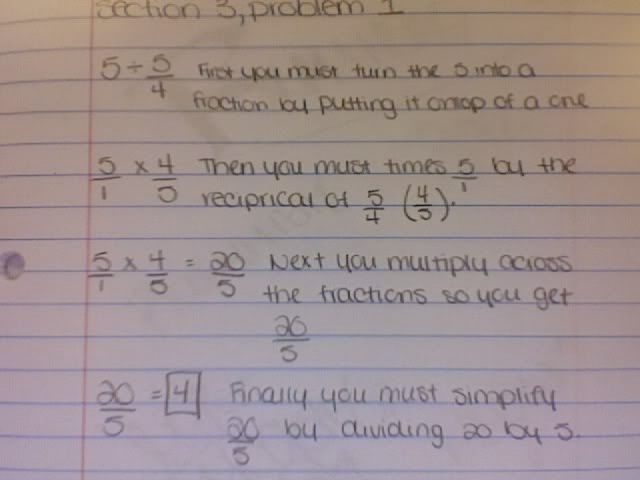
Megan Doe--> multiplying fractions
http://i108.photobucket.com/albums/n15/danceupchick/Photo610.jpg
click the link to see a picture of the problem done step by step :D
click the link to see a picture of the problem done step by step :D
Decimals
Here's how to convert .125 to a fraction...
There is not much that can be done to figure out how to write .125 as a fraction, except to literally use what the decimal portion of your number, the .125, means.Since there are 3 digits in 125, the very last digit is the "1000th" decimal place.
So we can just say that .125 is the same as 125/1000.
The fraction
is not reduced to lowest terms. We can reduce this fraction to lowest
terms by dividing both the numerator and denominator by 125.Why divide by 125? 125 is the Greatest Common Divisor (GCD)
or Greatest Common Factor (GCF) of the numbers 125 and 1000.
So, this fraction reduced to lowest terms is
So your final answer is: .125 can be written as the fraction
Thursday, December 20, 2007

Equations
o We find the M.C.M of 5,4,2,4 = 20, so we multiply everything by 20 so it allows us to created and easier expression.
o We put all the variables on one side, and all constants on the other side.
o In order to find x we divide 30 by 2.
¾ x – ¾ = ½ x + ¾
60/5 x – 60/4 = 20/2 x + 60/4
12x – 15 = 10x + 15
12x – 10x = 15 + 15
2x = 30
x = 30/2
x =15
o We put all the variables on one side, and all constants on the other side.
o In order to find x we divide 30 by 2.
¾ x – ¾ = ½ x + ¾
60/5 x – 60/4 = 20/2 x + 60/4
12x – 15 = 10x + 15
12x – 10x = 15 + 15
2x = 30
x = 30/2
x =15
Wednesday, December 19, 2007
Sequences
Sequence equations rely on previous values to derive new ones. They use formulas that help find the ext one, instead of guessing. Arithmetic sequence is when your adding together or subtracting, Geometric is multplying or dividing. The Recursive formula, helps you find the next value in the graphing, but when you use the Explicit frmula, you can use it to find any number, without depending on the last one.
Example (Geometric//Recursive):
A(n)=(An-1) x 3
n An
_
1 3
2 9
3 27
4 81
Combining Alike Terms
When combining like terms, some people who are not very experienced with this topic commonly do the same thing. This thing is combining things that seem to be alike, but are not.
For example, you can combine -6a+-4a. However you cannot combine them if one of them has an exponent.
For example you cannot combine
 , because -4a does not have an exponent.
Here is an example of how to combine like terms,
6a - 5 - 4 - 2a - 7
6a + -2a = 4a
-5 + -4 + -4 = -16
So now after combining the terms that are alike your new equation is,
4a - 16
For example, you can combine -6a+-4a. However you cannot combine them if one of them has an exponent.
For example you cannot combine
 , because -4a does not have an exponent.
Here is an example of how to combine like terms,
6a - 5 - 4 - 2a - 7
6a + -2a = 4a
-5 + -4 + -4 = -16
So now after combining the terms that are alike your new equation is,
4a - 16
Subscribe to:
Posts (Atom)